Five Chinese directors Italy doesn't know. And that says more about Italy than about China.

Not Ang Lee. Not Zhang Yimou. The generation after, the one European festivals celebrate and Italian audiences can't find in theaters.
There's a paradox that repeats itself every year, as reliable as the calendar. Venice, Cannes, Berlin award Chinese films. European critics write about them. Then those films disappear, not because they don't exist, but because they don't arrive.
In Italy, contemporary Chinese cinema is still stuck in a 1990s imaginary: Zhang Yimou, red lanterns, ancestral landscapes. Meanwhile, a generation of directors has completely rewritten the language of world auteur cinema. They did it without waiting for anyone. And without waiting for us.
These are five names you should know. The fact that you don't isn't your fault. But it isn't neutral either.
1. Bi Gan: the poet who reinvented time

Born in 1989 in Kaili, Guizhou province, Bi Gan debuted in 2015 with Kaili Blues and made it immediately clear he wasn't speaking the same language as anyone else. Self-taught, he came to cinema through Tarkovsky, Hou Hsiao-Hsien, and Wim Wenders, the directors you discover when you skip class and sit down in front of a screen.
The heart of Kaili Blues is an uninterrupted 41-minute long take moving through a hill village following the protagonist. It's not a technique for its own sake. It's a way of thinking about time as visual material, malleable, non-linear. The kind of cinema Italy still associates almost exclusively with European tradition, Resnais, Antonioni, Tarkovsky, coming here from a thirty-year-old from a provincial city in southwest China who filmed weddings to pay the bills.
In 2025, Resurrection came out, his third feature, a sci-fi detective story presented at the Quinzaine des Cinéastes at Cannes. Bi Gan is thirty-six years old. In Italy, nobody knows who he is. In Italian theaters, meanwhile, there's yet another superhero film.
2. Diao Yinan: noir as an anatomy of contemporary China
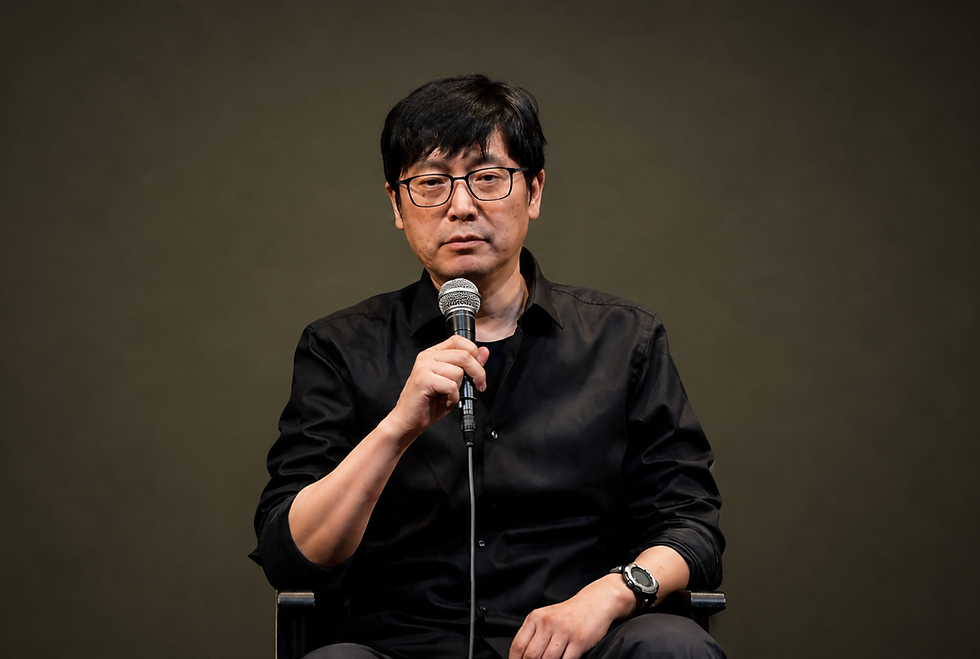
Diao Yinan was born in 1969 in Xi'an. He's considered a member of the sixth generation of Chinese cinema, the one focused on realism and urban crime stories. But calling him "a Chinese noir director" is like calling Visconti "an Italian who makes long films."
Black Coal, Thin Ice (2014), original title: Daylight Fireworks, is a thriller written and directed by Diao that won the Golden Bear at the Berlin Film Festival. A suspended, alcoholic detective reopens an unsolved murder case. Industrial northeastern China as a moral landscape as much as a physical one. Diao builds a potentially lurid mystery without a single gram of sensationalism: the cold of Heilongjiang isn't scenography. It's an existential condition.
After Berlin, Diao moved south for The Wild Goose Lake (2019), presented at Cannes: a hunted gangster searching for a double to whom he can hand off his identity, while a mysterious woman offers him a way out. Shot almost entirely at night, with a color palette that references American noir filtered through Wong Kar-wai. A film that resembles nothing else circulating in the Italian arthouse circuit.
A film that perhaps for exactly that reason never made it here.
3. Chloé Zhao: before she became Marvel

Yes, you know her. But not in the right way.
In Italy, Chloé Zhao exists as a name: the Chinese director who won the Oscar for Nomadland and then made Eternals. It's a version of her completely flattened onto the final result, the crowning achievement, the industry. The interesting part came before all that.
Born in Beijing in 1982, her first film Songs My Brothers Taught Me (2015) debuted at Sundance. Her second, The Rider (2017), won the Art Cinema Award at the Quinzaine de Cinéastes at Cannes. It tells the story of Brady, a young cowboy and rodeo rider who, after a serious head injury, has to reckon with the end of everything that defined him. The lead plays a fictionalized version of himself.
Her approach brings something into American independent cinema that comes clearly from the fifth and sixth generations of Chinese filmmaking: the sense of space, landscape cinematography, the ability to balance uncomfortable themes with narrative precision.
Eternals made her famous. It also made her less visible. In Italy we discovered her late and in the wrong way, as almost always happens with Asian directors: once they've already become a product.
4. Vivian Qu: the most political voice in independent Chinese cinema

A producer before she was a director. Vivian Qu, Chinese name Wen Yan, produced Black Coal, Thin Ice (2014), the film with which Diao Yinan won the Golden Bear in Berlin. Then she started directing. And what she's made can't be separated from the context in which she made it: a woman working in independent Chinese cinema, in a country where independent cinema exists despite the system, not because of it.
Her second feature, Angels Wear White (2017), competed at the 74th Venice Film Festival, where Qu was the only female director in competition. Her directorial style is influenced by Robert Bresson: visual economy, no sentimental emphasis, characters trapped in mechanisms that overwhelm them without ever fully understanding them.
Vivian Qu was the first female director to win best director at both the Golden Horse Awards and the China Film Director's Guild Awards. Her cinema is simultaneously personal and structural, intimate and indignant. It hasn't made it to Italy. That's not a coincidence.
5. Wang Bing: the living archive of a disappearing China

Wang Bing isn't unknown in European auteur cinema circles. The Centre Pompidou dedicated a retrospective to him, Cannes has hosted him multiple times. But he doesn't belong to the Italian cultural mainstream, and that in itself is an anomaly, because what Wang Bing does has no equivalent in contemporary world cinema. He's the kind of filmmaker you either include in the canon or admit the canon has a problem.
Born in 1967, Wang Bing is considered one of the most important documentary filmmakers of our time. His debut, Tie Xi Qu: West of the Tracks (2002), is a nine-hour documentary about the demolition of the Shenyang industrial district: workers, families, housing blocks, factories going dark. No voiceover. No music. Just the camera watching, patient and uncompromising, a China disappearing in the moment it was being filmed.
Dead Souls (2018) is an eight-hour work in which Wang Bing interviewed over 120 survivors of the Gobi Desert reeducation camps built during Mao's anti-rightist campaign in the 1950s. Presented out of competition at Cannes. 100% of reviews on Rotten Tomatoes are positive.
In Italy, no distributor acquired it. Eight hours of direct testimony about one of the most suppressed chapters of twentieth-century Chinese history, and the Italian distribution system decided it wasn't marketable.
The problem isn't geographical distance
These five directors have won or competed at the most important festivals in the world. We're not talking about underground cinema. We're talking about the mainstream of international auteur film. Locarno, Berlin, Cannes, Venice. Real prizes. Real criticism. Real audiences, everywhere except here.
Italy's problem isn't disinterest in foreign cinema. Italy has a serious cinephile tradition. The problem is selective: Asian cinema arrives when it's already been pre-digested by someone else, when it already has an Oscar, when it's already a case. It arrives late and flattened, stripped of the context that makes it readable. And in the meantime the directors keep making films, the festivals keep awarding them, and we keep talking about Zhang Yimou.
Zhang Yimou is eighty-two years old. Chinese cinema didn't wait for anyone.


Comments