K-dramas, Money and Inequality

Every K-drama is about money. Even the ones that seem to be about something else.
That might sound like an overstatement, but it operates almost like a structural law: behind every impossible love story, every chaebol heir falling for an ordinary girl, every mother consumed by getting her child into the right university, there is an economic system determining who can love whom, who can live where, who is allowed to dream what.
K-dramas do not use inequality as a backdrop. They use it as an engine.
South Korea has one of the highest Gini coefficients among OECD countries. Economic inequality is structural, built alongside the postwar industrial miracle and consolidated by the chaebol, the vast family-owned conglomerates that control a huge share of national GDP. Samsung, Hyundai, Lotte: names embedded in the daily life of every Korean, and in nearly every successful K-drama, directly or by implication.
K-dramas about rich and poor: more than a romantic trope
Searching for K-dramas about rich and poor usually leads to love stories with social tension, and there are hundreds. But the titles that have lasted, the ones still being discussed years after airing, are those that use that tension not as a romantic obstacle but as a diagnosis.
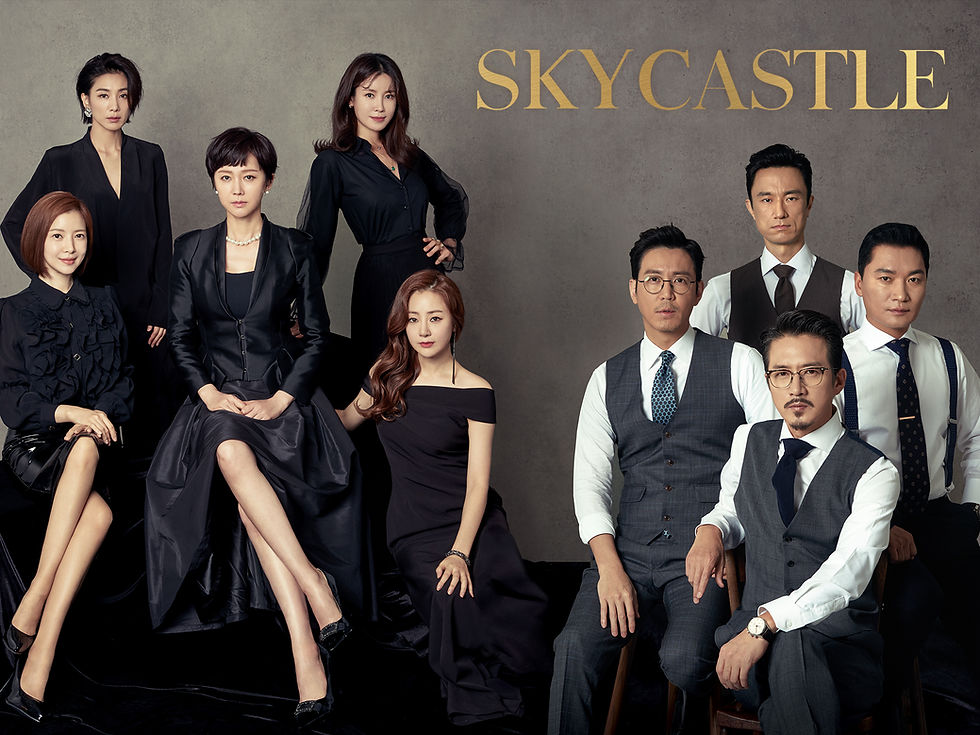
Sky Castle (2018-2019) is probably the most explicit K-drama ever made about the education system and class inequality. A sharp satire of Seoul's academic elite, of mothers who turn schooling into class warfare, of the psychological cost paid by those inside the fortress and those who cannot enter it. It recorded some of the highest ratings in Korean drama history. Audiences recognized themselves — or recognized someone they knew. Watch it on prime: https://www.primevideo.com/-/it/detail/0MR1IAA1RQ819GAMYYVIEI5ODG
My Mister (2018) works more quietly. On the surface, it is the story of two lonely people finding each other. In reality, it is a precise portrait of what it means to be born on the wrong side: the family obligations you never chose, the unnamed accumulating exhaustion, dignity as the only form of resistance still available.
Lee Sun-kyun, in his most precise performance, embodies an entire middle class holding everything up while no one notices. Watch on Viki: https://www.viki.com/tv/35740c-my-mister?utm_source=global_search_or_media_action&utm_campaign=35740c#episodes

Squid Game (2021) is the K-drama about inequality that reached global scale.
The metaphor is almost brutally direct: poor people play to survive, rich people watch for entertainment. What struck audiences worldwide was not the allegory — it was the recognition.
The feeling of playing a game whose rules you did not write.
Watch on netflix: https://www.netflix.com/watch/81262746?source=35

Parasite (2019) a film rather than a drama, but impossible to exclude from any conversation about K-dramas and money — compressed into two hours what Korean dramas explore across dozens of episodes: the house as class metaphor, the basement as destiny, the staircase as the only direction that is simultaneously possible and impossible.
Four Oscars, the Palme d'Or at Cannes, and a question still unanswered.
Watch on prime: https://www.primevideo.com/dp/amzn1.dv.gti.057bc08a-423d-4868-83e6-d77584491b3b?autoplay=0&ref_=atv_cf_strg_wb

Why K-dramas keep coming back to money
The answer is not that Koreans are more obsessed with wealth than anyone else.
It is that in a country where the right university determines the job, the job determines the marriage, the marriage determines the neighborhood, telling a story without money would mean telling a false one.
Chaebol dramas, a subgenre built around the great conglomerates, are often read as aspirational fantasy: the wealthy heir, the ordinary girl, love that transcends class barriers. But even the lightest among them carry a realistic undertow: those barriers exist, they are concrete, and they are almost never truly crossed.
Love passes through them in fiction. In real life, the zip code matters.
What the best titles share is not a happy ending or its absence. It is the gaze: clear-eyed, resistant to easy redemption, capable of holding complicity and anger in the same frame.
The question K-dramas' best entries never resolve, and that makes them narratively more honest than many Western equivalents, is whether the system changes, or only who manages to climb it.


Comments