Thai fashion doesn't just answer to trends. It answers to the crown.

From Italy, Thai fashion reads like an emerging market. A growing creative scene, a few names to watch, some interesting designers doing interesting things. What almost never gets read is the system of unwritten rules operating before a designer even picks a colour or cuts a fabric.
In Thailand, fashion is not only expression. It is negotiation with a symbolic order that carries the weight of law.
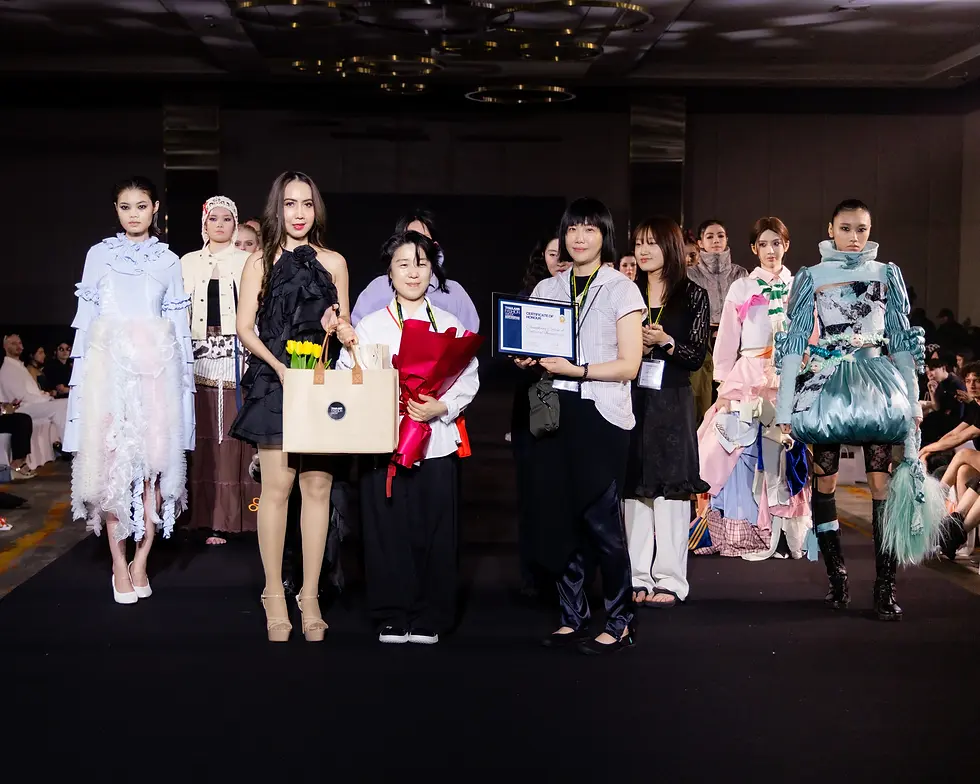
Thailand Fashion Week AW'26-27 just wrapped, May 27 at The Halls Bangkok. The lineup included designers from South Korea, Indonesia, the Philippines, Colombia, and India. Very few Thai names, in a fashion week named after the country. This is not a paradox. It is data.
And it says something about where the real conversation around Thai fashion takes place, and who controls it.

Colour is never neutral. In Thailand, it never has been.
In Thailand, colours are linked to the days of the week, rooted in Hindu astrology and pre-Buddhist animist beliefs. Yellow is Monday's colour, and with it the monarchy's: King Bhumibol Adulyadej, the country's most beloved ruler, was born on a Monday.
Blue is Friday's colour, the birthday of Queen Mother Sirikit. These are not folkloric details. They enter collective wardrobes, public events, and the way a brand or institution chooses to present itself.
When Bhumibol was hospitalised in 2016, Thais began wearing pink as a gesture of solidarity and hope for his recovery. After his death, demand for black mourning garments was so high that stores ran out of stock.
This was not fashion. It was cultural compliance. And the distance between the two, in Thailand, is not always clear.
DON CRISTOBAL AW26-27 COLLECTION AT THAILAND FASHION WEEK DON CRISTOBAL AW26-27 COLLECTION AT THAILAND FASHION WEEK
The law exists. And it reaches into the wardrobe.
Thailand has some of the world's strictest lese-majeste laws. Article 112 of the criminal code punishes anyone who defames, insults, or threatens the king, queen, heir apparent, or regent with sentences of up to 15 years.
What may surprise is how far this perimeter extends into aesthetics.
In 2018, a Thai YouTuber faced legal action for criticising on Instagram a ceremonial gown worn by Thailand's Miss Universe contestant. The dress had aesthetic elements linked to the royal family. The accusation: irresponsible behaviour damaging the country's reputation.
A case that looked like it was about fashion but was really about the boundary between criticism and lese-majeste.
This does not mean Thai designers cannot work. It means they work inside a gravitational field that most Western observers do not see, or choose not to.
Who builds the identity?
The central figure in this story is Queen Mother Sirikit, who passed away in October 2024. She defined the aesthetic foundations of modern Thai fashion: in the 1960s, alongside a team of historians and local designers, she created the eight formats of the traditional Thai costume (Chut Thai), preserving the country's textile traditions through the SUPPORT Foundation.
Her collaboration with Pierre Balmain, lasting over thirty years, brought Thai silk into Parisian runways and international diplomatic circuits.
Princess Sirivannavari Nariratana, her granddaughter, continues this work with a more contemporary orientation. Her SS26 collection "The Eternal Nautilus" incorporated Don Koy indigo-dyed fabrics and hand-woven hemp from Chiang Mai community projects. In May 2026, she became the first Fashion and Design Ambassador of WIPO, the World Intellectual Property Organization.
A recognition that goes beyond the personal: it certifies the Thai model of weaving heritage, royalty, and creative industry into a single, legible narrative.
The point is not to celebrate this model. It is to understand that it exists, that it has weight, and that it shapes the scene we observe from the outside in ways far deeper than Western fashion press tends to acknowledge.
Thai designers worth following now.
Beyond the royal system, there is a creative scene working inside and around these tensions. These are the names worth knowing:
ISSUE (fondatore: Bhubawit Kritpholnara): conceptual approach, sustainability focus, and a reinterpretation of Thai craft codes in contemporary terms.
The FW2025 collection reread traditional basket-weaving as a fashion language.
ASAVA: one of the Thai brands with the most established international following. A rewriting of the classic, with strong material quality and attention to construction. A reference point for understanding where Thai tailoring positions itself.
PAINKILLER Atelier: menswear with a strong identity and a recognisable point of view. More edgy than ASAVA, more narrative than many contemporaries.
NAGARA: part of the BIFW roster, works in a more minimal and structured register. Worth watching for how it manages the tension between local heritage and international market.
PATINYA: feminine, with a consistent aesthetic built over time. Present beyond Thailand (Cambodia). One to follow for anyone looking for an entry into the Thai luxury system.
Greyhound Original: the most internationally recognised name. Minimalism, wit, and a capacity to translate Bangkok's mood into wearable garments. A useful calibration point.
Thai fashion is not understood by looking at the runway alone. It is understood by looking at the system in which the runway exists: who authorises it, which colours can be worn, which critiques can be made. Italy watches from a distance.
Perhaps it is time to look closer.
What is Thailand Fashion Week?
Thailand Fashion Week is a biannual international fashion event held in Bangkok, with runway shows across Couture, Femme, Homme, and Avant-Garde categories. The AW'26-27 edition took place on May 26-27, 2026 at The Halls Bangkok.
Why do colours have special significance in Thailand?
In Thailand, each day of the week is associated with a colour, rooted in Hindu astrology. Yellow is the colour of the monarchy because King Bhumibol Adulyadej was born on a Monday. Blue is linked to Queen Mother Sirikit. These associations influence how citizens, institutions, and brands dress for public occasions.
Who is Princess Sirivannavari and what is her role in fashion?
Princess Sirivannavari Nariratana is the granddaughter of Queen Mother Sirikit and the creative director of the fashion label bearing her name. She works with traditional Thai materials including Don Koy indigo and Chiang Mai hand-woven hemp. In May 2026 she became the first Fashion and Design Ambassador of WIPO.
Which Thai designers are most relevant to follow?
Among the most significant names in contemporary Thai fashion: ASAVA, ISSUE, PAINKILLER Atelier, NAGARA, PATINYA, and Greyhound Original. All showed at Bangkok International Fashion Week 2025 (BIFW2025).
How do lese-majeste laws affect fashion in Thailand?
Thailand's lese-majeste laws are among the world's strictest, protecting the royal family from criticism or insult. Their reach extends into the aesthetic sphere: there have been documented cases where criticism of a garment with royal aesthetic elements was reported as a potential violation of these laws.


Comments