Yohji Yamamoto and the Japanese fashion Italian fashion has only just caught up with.

Yohji Yamamoto never disappeared. Italian fashion just arrived there late. What is now celebrated as formal rigor, as an intelligent rethinking of garment construction, is often a language that Japanese fashion had already built more than forty years ago.
Deconstruction, anti-silhouette, visible construction, intentional imperfection: these are not inventions of 2026. They are central elements of a visual system that Yohji Yamamoto, Rei Kawakubo, and Issey Miyake had already turned into method between the late 1970s and the 1980s.
The issue is not that Italian fashion looks at Japan. That would be a naive complaint in an industry built on influence, circulation, and cultural appropriation. The issue is something else: when Japanese fashion enters the European conversation, it often does so without full credit, without declared genealogy, without any real acknowledgment of debt.
It is treated like mood, never like origin. Like suggestion, never like structure.
Japanese fashion already wrote this language
In 1981, Yohji Yamamoto arrived in Paris and broke the implicit contract of Western elegance. Exposed seams, unfinished edges, construction left visible: these were not technical details. They were a position. The garment stopped pretending to be perfect. It showed process, tension, labor.
At the time, Europe read that gesture as a rejection of beauty. Today, the same visual logic is praised as sophistication and radical intelligence. The distance is not aesthetic.
It is historical. Japanese fashion opened that fracture decades before the Italian system decided it was desirable.

The same goes for Rei Kawakubo and the destruction of silhouette as the mandatory measure of the body. With Comme des Garçons, volume no longer existed to flatter anatomy. It disrupted it. It refused it.
The body stopped being the moral center of the garment. This is one of the deepest contributions of Japanese fashion: it broke the assumption that clothing must always serve the figure, organize it, and make it readable.
Today, many Italian and international collections work through this same suspension, through a silhouette that questions rather than defines. But the real question is where that freedom came from.
From Yohji Yamamoto to Issey Miyake, the aesthetic debt is still visible
Then there is Yohji Yamamoto and imperfection as method. Abrasion, asymmetry, disorder, visible wear: not as random effect, but as aesthetic and political value. In a system that linked luxury to total control, Yamamoto introduced visible failure, friction, and damage.
It was not the stylization of poverty. It was the rejection of the idea that beauty had to mean polished, finished, and clean. When Italian fashion now recovers ruin as a visual language, it is not inventing a new sensitivity. It is entering a tradition already written, already defended, already paid for by others through critical hostility.
Yohji Yamamoto, “Yamamoto '87,” Japanese Modernism Across Media, accessed May 18, 2026, https://ds-a Yohji Yamamoto, “Yamamoto '92 menswear,” Japanese Modernism Across Media, accessed May 18, 2026, htt
Issey Miyake also moved the conversation far beyond garment design. His pleats, his almost origami-like constructions, his idea of fabric as autonomous architecture did not exist to follow the body, but to produce a form independent from it.
Here Japanese fashion does not simply add decoration to Western tailoring. It changes its logic. The garment does not accompany the body. It contradicts it, exceeds it, sometimes ignores it. That is a structural transformation, not a stylistic one.
Visible construction is another point that Italian fashion still treats as if it were a contemporary intuition, when in fact it has a very clear genealogy. Rei Kawakubo had already turned outward what the European system wanted to keep hidden: linings, padding, interiors, framework.
Showing the mechanism meant rejecting the illusion of the garment as a perfect surface. It meant declaring that form is never innocent, that every piece carries structure, discipline, and tension inside it. Today, this aesthetic returns in many Italian collections as a sign of modernity. But it is not spontaneous modernity. It is selective memory.
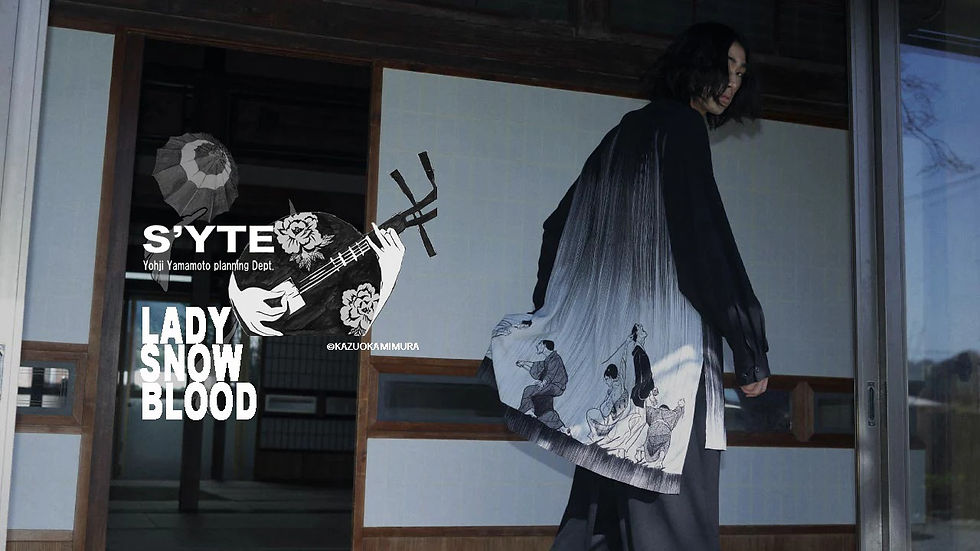
S’YTE proves Yohji Yamamoto is not an archive
Today, this logic does not survive only in Yohji Yamamoto’s main line. It also continues through more accessible and lateral projects within his universe, such as S’YTE.
S’YTE S’YTE S’YTE S’YTE S’YTE S’YTE
Designed by Yohji Yamamoto’s atelier team, the brand is built on an explicitly anti-fashion spirit and develops two of the designer’s core principles: cut and silhouette. Here too, the point is not to dress the body in a reassuring way, but to disrupt how it is read. Form does not follow anatomy. It shifts it, loosens it, contradicts it.
The fact that this grammar keeps regenerating through a genderless line like S’YTE makes one thing clear: Yohji Yamamoto is not a historical reference to be cited from a distance. He is still a living system.



Comments