The '80s are back.
- Valentina Bonin

- 3 hours ago
- 3 min read
But not the way you think. It's not the silhouettes. It's the attitude.
If you look closely at this year's collections, the looks circulating on social media, the backstages of concerts and shows, you can feel something shifting in the air - but you can't quite put your finger on it. It's not about padded shoulders or neon.
It's not a classic aesthetic revival. It's something subtler, and at the same time far more radical: it's the way clothes are worn, the level of intention behind every choice, the sheer amount of visual construction people are willing to put into their morning routine before stepping out the door.
80s fashion in 2026 is not coming back as a copy of a decade most of us never lived through. It's coming back as behaviour. As a philosophy of the self. As cultural permission to be, finally, too much.


80s fashion: being “too much” is acceptable again
For at least a decade, we were sold an aesthetic ideal built on subtraction: less colour, fewer accessories, less visual noise. Minimalism dominated the fashion system and the way we presented ourselves online, constructing an idea of "good taste" that almost always meant removing, simplifying, toning down. Being noticed felt like a mistake.
Now the opposite is happening, and it's happening pretty clearly. Make-up has become architecture on the face again. Looks are built with a level of care that's closer to set design than wardrobing.
Styling no longer seeks a reassuring balance - it goes for immediate, almost cinematic impact. The goal is not to look effortless. It's to look exactly the way you decided to look.
And this is more than just an aesthetic shift: it's a statement. Taking up visual space deliberately also means reclaiming the right to have an image that doesn't apologise to anyone. It's a political choice dressed up as a style choice - as it has often been, historically, in the decades of greatest visual intensity.
Identity becomes a performance again
There was something very clear about the '80s, which you catch watching documentaries, looking at photos from that period, watching music videos: identity wasn't something that naturally emerged from within a person. It was something you built, wore, decided - often daily, often radically different from the week before.
Madonna changing her face with every album. Prince inhabiting ten different aesthetics in the same year. It wasn't inconsistency, it was freedom.

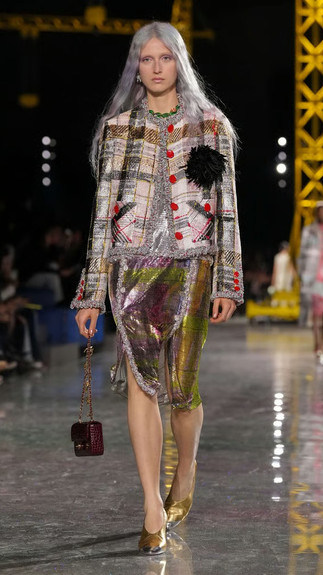


Autunno-Inverno 2026/27 - Womenswear - Milano - ©Launchmetrics/spotlight
Today the same thing is happening again, at a different scale and through different tools. Outfits are conceived as characters - there's a narrative behind every look, an intention that goes beyond "I like this."
Looks shift from day to night with a fluidity that doesn't seek coherence, but seeks recognizability. Aesthetics don't need to hold together in a uniform system: they need to leave an impression.
The logic is no longer "you should just be yourself." The logic is: you need to be readable. You need to leave something in the mind of whoever's watching, even for just a second on a story that disappears in twenty-four hours. Identity as performance is not superficiality - it's awareness of the medium.
And that's exactly what the '80s understood before anyone else.
More image, less authenticity: or maybe not
Here's the interesting part, where the conversation gets complicated in the right way. We live in a cultural moment obsessed with authenticity - the word is everywhere, used to sell everything from a sneaker brand to a personal branding narrative. And yet we're clearly moving back toward building very precise, almost artificial images, crafted with a level of care that has nothing spontaneous about it.
Is that a contradiction? Maybe. Or maybe the construction of image has always been its own form of authenticity - not in the sense of total transparency, but in the sense of conscious control over your own representation.
Choosing how you want to be perceived, and actively working toward it, is an act of will that says something true about you.
Sometimes truer than the "no-filter" realness that ends up being its own kind of performance.

CZMOS Take
We're not going back to the '80s because we miss them. This isn't nostalgia, it's not creative laziness, it's not the fashion system recycling the same cards twenty years later.
We're going back because being neutral doesn't work anymore. In a context where everything competes for attention, choosing not to choose has become the most losing strategy there is.
And that decade - loud, excessive, constructed to the bone - had already understood something we're only now rediscovering: that image is a language, and if you want to be heard, you first need to learn to speak it out loud.


Comments