

IN BEAUTY VERITAS: imperfect beauty as resistance
- CZMOS Redazione

- 2 days ago
- 2 min read
In Beauty Veritas is not a project about beauty. It is a project against beauty as a social obligation.
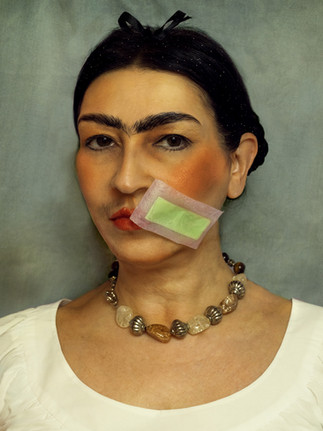
Through her work, Daisy Peluso frames contemporary imperfect beauty as a critical stance. The body is no longer something to be corrected, but something to reclaim. Iconic faces from art history are reactivated and disrupted, marked by masks, patches, visible interventions.
There is no nostalgia here. Only tension.
The body as artwork, the artwork as pressure zone
By comparing the human body to a work of art, Peluso exposes the opposite mechanism: today, artworks and bodies alike are normalized, standardized, stripped of complexity.
Contemporary imperfect beauty becomes a form of visual resistance.Each alteration reveals the pressure to adapt imposed by the present.
The body turns into an archive of fragility, culture, and identity.


New standards, same violence
Old beauty standards never disappeared. They were rebranded.
Peluso shows how new aesthetic models, supposedly inclusive, still generate exclusion. Difference is tolerated only when corrected, softened, made acceptable.
In this sense, contemporary imperfect beauty is not an alternative aesthetic. It is a political rupture.
By using classical art archetypes, In Beauty Veritas creates a temporal short circuit. The past is not celebrated; it confronts the present.
The verdict is clear: obsession with perfection has produced more controlled bodies, not freer ones.
The truth evoked here is not moral. It is physical.
Only self-awareness and love for difference can lead to a different ending. Not perfect. Not comforting. More honest.


Why CZMOS publishes this work
CZMOS rejects comforting visual culture. In Beauty Veritas matters because it exposes rather than resolves.
Contemporary imperfect beauty is not a trend. It is a necessity.
Who is Daisy Peluso — and why the past still bleeds
Daisy Peluso is a Southern Italian artist born in 1995, whose practice is rooted in a temporal fracture: the past is not an archive, but a living body.
After an initial background in socio-psycho-pedagogical studies, Peluso fully committed to art, earning both BA and MA degrees in Visual Arts, specializing in photography and painting. Her path is not linear, but layered — crossing disciplines, materials, and historical references.
Her work stems from a deep fascination with ancient art forms, from classical painting to early photography. Not as quotation, but as reactivation. Through material experimentation, Peluso forces the past and the present to collide, allowing one to survive inside the other.
I have always been fascinated by the past. Throughout my academic journey, I had the opportunity to study and engage deeply with ancient art in all its forms and expressions, from painting to early photography. In my work, I aim to merge the elements of the past and the present into a single reality through the experimentation with techniques and materials, allowing the former to be reactivated within the latter, and vice versa, in a new, shared dimension.


Comments