Songkran Thailand: between ritual and BL marketing, when culture becomes content
- CZMOS Redazione

- 2 days ago
- 3 min read
Songkran is not just water.
It’s not just chaos, celebration, or viral videos flooding TikTok and Instagram every April. It is one of the most meaningful moments in Thai culture — a collective ritual built on purification, memory, and renewal.
But in recent years, something has shifted. And that shift doesn’t concern the tradition itself, but the way it is observed, framed, and used.
Because today, Songkran Thailand is also a mechanism.
A peak visibility moment. And inevitably, a strategic space.
Traditionally, Songkran marks the Thai New Year. Water is not play — it is symbolic. A gesture to wash away the past, to let go, to step into a new cycle grounded in respect for family, elders, and Buddhist spirituality. It is slow, intimate, deeply rooted.
But in its contemporary form, the meaning of Songkran Thailand moves on another level as well.

Songkran Thailand today: from ritual to content
Songkran is also mass tourism, social media content, global exposure. And where attention exists, the industry follows.
In recent years, during Songkran Thailand, a specific pattern has emerged: actors — especially within the BL industry — are captured in moments that feel spontaneous. Physical closeness, subtle intimacy, gestures that suggest something more. Short clips, seemingly casual, yet spreading at an extreme speed.
They go viral.They activate fandoms.They build narratives.
And most importantly: they generate engagement.
The critical point is not the content itself, but the context. More and more Thai audiences are beginning to perceive this dynamic as a form of cultural instrumentalization. When a festival with religious and symbolic meaning becomes a backdrop for promoting “ships,” friction becomes inevitable — not only cultural, but generational.
BL marketing during Songkran Thailand
It’s important to be clear: BL marketing during Songkran Thailand is not accidental.
Agencies understand perfectly what this moment represents.
They know it’s one of the highest peaks of public attention.
They know that content perceived as spontaneous performs better. And they know that intimacy — even when only suggested — is one of the strongest drivers of sharing.
What they build, therefore, is not pure fiction.
It’s something more subtle.
Semi-organic situations: real moments placed within designed contexts to amplify their effect. Not fully scripted, but not left to chance either. An invisible form of direction with one clear goal: to feel natural.

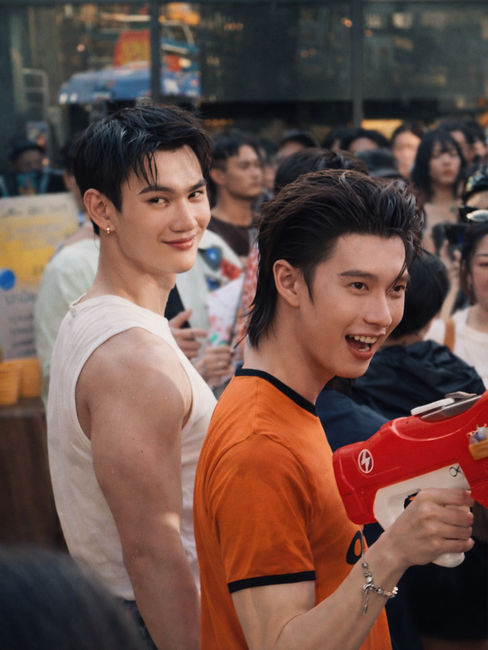


Fanservice 2.0: how the narrative is evolving
This is where what we can call fanservice 2.0 begins.
Before, fanservice existed in controlled environments — official events, interviews, stages. Now, it moves into what appears to be everyday life. Or at least something that looks like it.
“Stolen” videos, casual interactions, festivals, backstage moments. Real contexts that make the narrative more believable, more intimate, more powerful.
It’s no longer just entertainment.
It’s emotional construction.
Songkran Thailand: friendship or strategy
So the question remains: are they friends, or is it strategy?
The most honest answer is that both coexist.
Some artists are genuinely close, comfortable with each other, sharing real moments. But this does not exclude a broader structure: timing is studied, distribution is controlled, amplification is intentional.
Nothing is entirely artificial.
But nothing is entirely innocent either.




Why Songkran Thailand is the perfect environment
Songkran works perfectly for this type of marketing because it brings together elements that rarely exist in the same space.
It is physical — water, touch, proximity. It is emotional — energy, freedom, celebration. It is collective — everyone participates, everyone watches.
It is a space where the boundary between public and private dissolves.
And in that space, it becomes easier to turn intimacy into content.
The problem: culture vs industry
The real tension is not between fans and artists.
It is between culture and industry.
When a ritual is reinterpreted as a viral format, the risk is not just simplification. It is the loss of context. And without context, a tradition stops being a tradition and becomes an asset.
More and more people are starting to perceive BL marketing during Songkran Thailand as a form of cultural reduction. Not because the content exists, but because its original meaning is gradually pushed into the background.
Conclusion: what is really changing
Songkran has not changed. The way we use it has.
And maybe the most interesting question is not whether these moments are real or constructed.
But why we need them to feel real in order to believe them.


Comments